

ANZAC Day 2026 - Churchill
No-one could have asked for better weather for ANZAC Day Churchill 2026. It was perfect.
The Morwell Brass Band played hymns and other appropriate songs in the lead up to the ceremony.
Peter Townsend was the MC for the day as Don George who had filled the role for many years, was unwell. He welcomed Joanne Campbell, Leanne Potter and Melina Bath as guests for the occasion, then spoke the following words.
Welcome Address
‘At dawn on this day 111 years ago, Australian troops landed on a beach in a small cove, on the Gallipoli Peninsula, under heavy enemy fire for the first time in this campaign. This place would become known as ANZAC Cove.
Sixteen thousand ANZAC troops landed at Gallipoli on April 25, 1915, and on that day 620 Australians would be killed. By campaigns end an estimated 8,700 would die and another 18,000 would be wounded.
At the start of WW1 Australians from many backgrounds, religions and nationalities enlisted and fought and died for this country. Sayings such as courage, mateship, compassion, respect, honour and digger were forged in the carnage of Gallipoli, and in the trenches of the Western Front which are still synonymous with the Australian Defense Force today.
Due to the wide spread destruction and bloodshed, the remains of many service men were never recovered. The population of Australia at this time was estimated at 5 million 100 thousand. From that population approximately 416,800 people enlisted. Some 60,000 were killed and 156,000 wounded, gassed or taken as POW. A whole generation. Among those who died were some 25 nurses serving with the Australian Army Nursing Service.
The names on the cenotaphs and honour boards erected in almost every country town, community and city around Australia at the end of the war, is testimony to the sacrifice of Australian men and women.
We must also remember that the terrible conflict of WW2 came to an end some 81 years ago this year, where approx. 43,000 serving personnel lost their lives’.
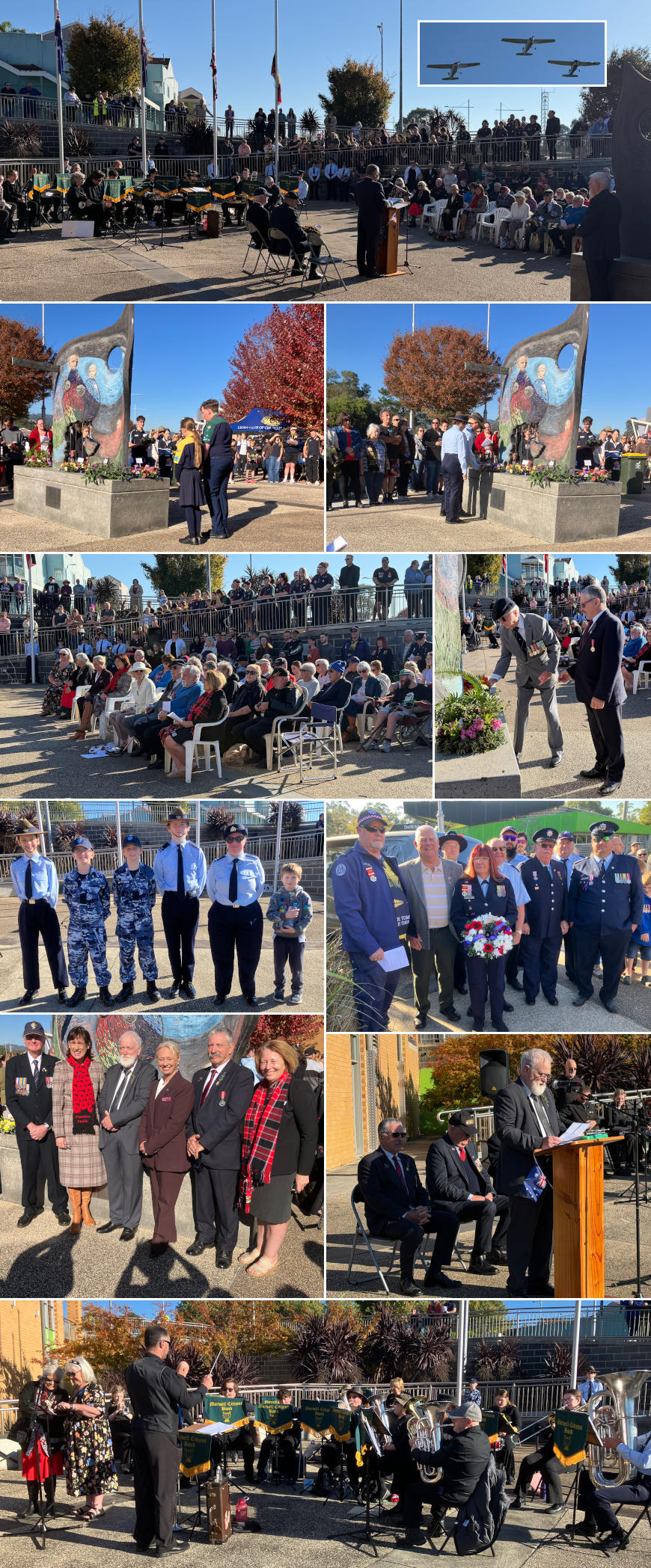
David Lyne, President of the Churchill Lions led the wreath laying ceremony with many groups participating from young to old.
Three planes from the Aero Club did a fly over.
Peter Tait was called upon to do the guest speech. Here follows his words.
ANZAC Day 2026
‘A sixteen year old boy waits to board the Silver Star train at the Wellington Railway station. It is the evening of January 3, 1978 and he is about to set off on a journey that will set the values and ethics around service and sacrifice that he lives by for the rest of his life. Things his parents could never teach him.
An extraordinarily long overnight trip to Auckland to be met by a friendly WREN ushering us on to the bus to take us to HMNZS Tamaki to start basic training. A Petty Officer GI met us and proceeded to inform us of the rules and procedures that we must follow. The rule that made the most impact for me was “You are no longer children, you have joined this man’s navy and you will behave like a man”.
We were expected to shave twice a day whether we needed to or not, wash our own clothes by hand and learn to iron. We knew how to embroider our names on our uniforms and replace a button. We learned to march, hold a rifle and fire it safely, hold formation and stand on parade for hours at a time without passing out.
We never went to war, never fired a shot in anger, but we practised. Weeks at sea closed up at action stations, fully kitted up with fearnought suit and breathing apparatus at the after damage control station, waiting for the call that there was a fire or a hole in the side that had to be repaired or that emergency cables were needed to keep the steering gear operational. Running, running, running, no time to dawdle, everyone’s lives depended on you pulling your weight.
50 years later I now think upon how lucky I was to not have had to engage in any combat arenas, to endure the urgency of true battle and all the associated fears and anxiety, to suffer the loss of good mates and to experience dealing with the effects of war upon a person’s body and mind.
I often dwell upon the fact that during the First World War there were child soldiers who had felt that in their hearts, they must join the army to fight. The youngest should have been 18 years old though they would have needed permission from their parents to enlist. The youngest, James Charles Martin died at the age of 14 years and 9 months at Gallipoli from typhoid. He lied about his age and as the army was frantically trying to raise numbers, there was little checking. There were those like the 12-year-old Perth boy Reginald Garth who stowed away on ships hoping to join the fighting. He was caught and sent home. And the young girl Maud Butler who not once but twice dressed up in khaki, cut her hair short and tried to jump on troop ships going to Egypt, was also caught and returned to her home.
What inspired these children to want to enlist? Was it the promise of adventure? Was it a sense of duty? Was it peer pressure or was it something else that only they could tell us. They are no longer with us and must never be forgotten. Lest we Forget’
Leanne Potter then introduced the students from our local schools to say what ANZAC Day means to them.
The School Captains from Kurnai Junior Campus Sage and Rahzel delivered the following words
‘ANZAC Day reinforces the concept of mateship and the strength of our bonds with the people of New Zealand who we fought alongside in many conflicts throughout history, giving us the ANZAC name. It is often the toughest of times that bring us together the most.
I remember during COVID-19 lockdown when we were limited with social connections. That year, we were unable to participate together in the ANZAC Day services. Instead, we got up before dawn and went to the end of the driveway and listened to the dawn service on the radio. We lit candles for those who made the ultimate sacrifice and also to acknowledge all the defense forces for the important duty they perform for everyday Australians. That day when I placed our family’s wreath on the driveway, I think the significance of ANZAC Day really came to me. During the minute of silence, I remembered those who had lost their family members, their friends, their partners. I listened and felt pride in the stories that were broadcast on the radio and later through TV shows. The noble and courageous actions that had been taken to save others’ lives during combat and the risks they took in order to protect us. It is difficult to comprehend how many of those who fought were not that much older than us’.
‘This year is the first time I was given the opportunity to be involved in ANZAC day. It feels really important and I have an appreciation for the words and traditions upheld during this ceremony.
Sadly, there is still much conflict in the world, and I hope we do not face anywhere near the extent of injury and loss of life that we have suffered in the past. Thank you to all the service men and women who are ready to defend our great country. Today we acknowledge and honour those serving and those who have served in the past and pay our deepest respects for all those who gave their lives. Let us carry their spirit with us, not just today, but every day in our lives. Let us be worthy of the legacy they have left us.
Lest we forget’. Sage
‘I have realised that when I was younger I did do many activities in primary school, like making red poppies, colouring in and baking ANZAC biscuits. I must admit that I did not really begin to understand the significance of these activities until high school.
Anzac Day for me means many things. For one it gives me pride in our nation. Pride that we can all come together to remember and pay our respects to those who lost their lives in wars for us, and for those who are currently serving our country at home and overseas.
ANZAC Day also reminds me how forever grateful I am. Grateful for the amazing life we have in Australia. Grateful for those who fought for us, for those who still fight every day for us. They have given us opportunities that we may have never had if they had not protected our country. For that I must always be grateful.
I personally believe that ANZAC Day is very important as it allows us all to gather and pay our respects for the fallen soldiers from Gallipoli and every war Australia and New Zealand participated in. When I talk to my peers, we all agree it is a day of significance for us and important to learn about every year at school’. Rahzel.
Our Primary School children from Churchill North, Churchill, and Lumen Christi delivered the following speeches.
Not all speeches had a name on them. Our apologies.
‘To me, ANZAC Day means that I remember the brave soldiers that fought in the war. I think that it is important that I go to ANZAC day so that I can show my respect to them and what they have done. I think it is good that we have the opportunity to come here and represent our school as the leaders. ANZAC day is a day to me where I can feel happy and sad at the same time because I am happy they fought but sad because many died. I am proud I am an Australian and I am thankful to be here today’. Ebony
‘To me ANZAC Day reminds me of the brave solders how they fought for us and showed bravery and we should all be thankful for the sacrifices they made for our country. It makes me feel extremely proud that my grandfather lived during World War 2 and that I am an Australian’. Lizzy
‘ANZAC Day is a special day because it is a time for us to remember the sacrifices of our fallen soldiers for our freedom.
ANZAC Day is important to me because I remember the soldiers who fought in the war and died courageously.
This makes me feel grateful for our freedom and peace we have in our country from our soldiers’. From Bailey
‘As we gather here today, I would like to remember the people that sacrificed their lives for us to live on freely and peacefully.
It means a lot to me because of my Pop and some of my other grandparents who were part of ANZAC which helps me feel so close to this day.
To me ANZAC makes me feel grateful that some people fought selflessly to protect our land and freedom’. By Quinton
‘Anzac Day is a special day when we stop and remember the soldiers who fought for Australia and New Zealand, especially the ANZAC’s at Gallipoli.
It helps us think about how brave they were and how hard life must have been for them, even when they were scared or far away from home.
A time to stop and to thank them for their courage for protecting our country.
We also remember the families who lost loved ones and the soldiers who still serve today.
ANZAC Day reminds us to be grateful for our freedom and to always treat others with kindness and respect’.
‘Good morning.
Today, along with Australians everywhere, we gather to remember those who have served to defend Australia. We do this because it is the anniversary of the day when Australian and New Zealand soldiers landed on the beach at Gallipoli in Turkey, on April 25, 1915.
We remember and honour the brave men and women who served our country in times of war, especially the ANZAC soldiers.
We thank them for their sacrifice and bravery. Because of them, we are able to live in a free country. Lest We Forget’
‘ANZAC Day is a day to remember the people who died for us. They sacrificed themselves for us, this country, this nation. These poppies rise each year just as our pride should.
This day means as an Australian we should Stop, Think, Reflect and Celebrate.
Our soldiers were scared when they heard and saw the gun fire. But they kept fighting for their Country. Our Country. And we would not be who we are today without them and their sacrifices. We thank them as they are all heroes.
Upon the blood-stained foreign ground, now comes a new growth - Poppies represent peace and victory. Let us thank all who went to war including my ancestors.
Thank you all for listening’.
‘Good morning everyone, service men and women and all present. I am here to tell you my thoughts about ANZAC Day. It amazes me how ANZAC Day is special and still a very big impactful day for our community. On behalf of myself and my school, and all the up and coming generations, I want to show my appreciation to those who have paid the ultimate sacrifice for our freedom. Thank you.
ANZAC Day is a day to remember all those brave soldiers who gave their live and fought so that I could live free in Australia’.
‘Good morning everyone and thank you for coming. Today we commemorate 111 years of ANZAC service and remember those who served and died in the war. We gather here to show our appreciation for the service of all veterans and currently serving men, women and animals, as it takes great courage and mateship. Thank you for your service. Lest we forget’.
Leanne Potter congratulated the students, saying how proud it made us feel to hear their words. We have some wonderful young people to be our future.
Conlcusion
Cathie Halliwell from the Co-Operating Churches prayed a very meaningful prayer for the day.
Peter Townsend read the Requiem, Then the Ode to the Fallen was said by Bruce Jeffrey OAM, who also thanked the organisers and everyone for their attendance.
The Last Post and Reveille were played by Joseph Bonnici with a silent tribute between.
Bobby Nardu and Sue Townsend sang the New Zealand and Australian National Anthems. They were accompanied by the band.
The Lions Club provided an excellent breakfast. The Rotary Club provided tea, coffee and ANZAC biscuits.
It was a very social gathering with lots of friends to greet and thank, but with the ultimate aim to celebrate ANZAC Day with dignified ceremony.
Thank you everyone for your respectful attendance, and to all who participated.