

Looking Back - June 2026
By Leo Billington
Local historical gems for our community
In last month’s CDN, I wrote about Peter Bertrue being quite a saviour for the good folk of Morwell back on January 28, 1888, when he was given a permanent appointment “to the office of scavenger.” His Key Performance Indicator (KPI) was to restore the town to a “wholesome condition.”
Toward the later months of 1907, Peter and family moved to Tara in Queensland. They possibly moved at a time when Queensland, around Toowoomba and near towns, was opening up properties for sale. Unfortunately, the area around Tara was prickly pear country and very hard to clear and settle on. Even today it is not considered good farming land.
It was a coincidence that Tara is where Benjamin Walter Benn became a Councillor with the first Council there, and has a street named after him - Benn Street.
Some of these early settlers, apparently were not daunted, as was Benjamin Walter. In October 1913, he explained in a letter to the editor (Farmer and Settler Sydney, NSW : 1906 - 1955, Tuesday October 28, 1913), a “sure-fire” method to protect fruit trees from rabbits and hares.
“1 notice that you have an inquiry from someone as to how to prevent rabbits and hares from barking fruit trees. I have followed a certain plan for years, and have never had a tree damaged since. Take some fresh cow dung, put it into an old tin or bucket, add sufficient water to make it of the consistency of thin mud and paint the butts of the trees occasionally. Nothing will touch the tree afterwards. This treatment also cures woolly aphis on apple trees.”
For a while Benjamin Walter was a local celebrity in Tara. In later years, members of the Benn family were farming in the Dumbalk North area.
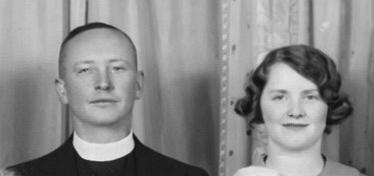
Here is the link to Morwell’s early history. From a story about an appointment “to the office of scavenger.”, and a Melbourne reader of CDN, we learn more about the Reverend Leslie William Alfred Benn. Born in 1896, and second eldest of 11 children, his parents farmed at Dumbalk North. For seven years, 1928 to 1935, Leslie William Alfred Benn was Rector of St Mary’s Anglican Church in Morwell (see accompanying photograph).
On Monday June 8, 1936, he gave a farewell speech at jubilee celebrations of the church; a function celebrated in the Morwell Fire Brigade Station. In part, he said:
“We have a fine block of land on the Highway, on which
is the Morwell Rectory, and I would urge you to make plans now for the future for a new church.”
The Church complex was moved to that corner in Latrobe Road during 1929. Prior to this site, its location was in Chapel Street. The foundation stone of the present church complex in Latrobe Road was unveiled in 1958 and completed in 1980.
At the current Latrobe Road location, construction of a new vicarage was managed by Mr Stan Winchester, who was married to Leslie William Alfred Benn’s niece.
There is more to this story; a link was made via the CDN being read in Melbourne.
Now cars and petrol, a topic recently given huge media coverage in months past, and perhaps in the future as we wade onwards.
In the early 1950’s a particular brand of car was being advertised - not a GMH or Ford or anything British, but a Simca. Fancy a French car being advertised in an English colony!
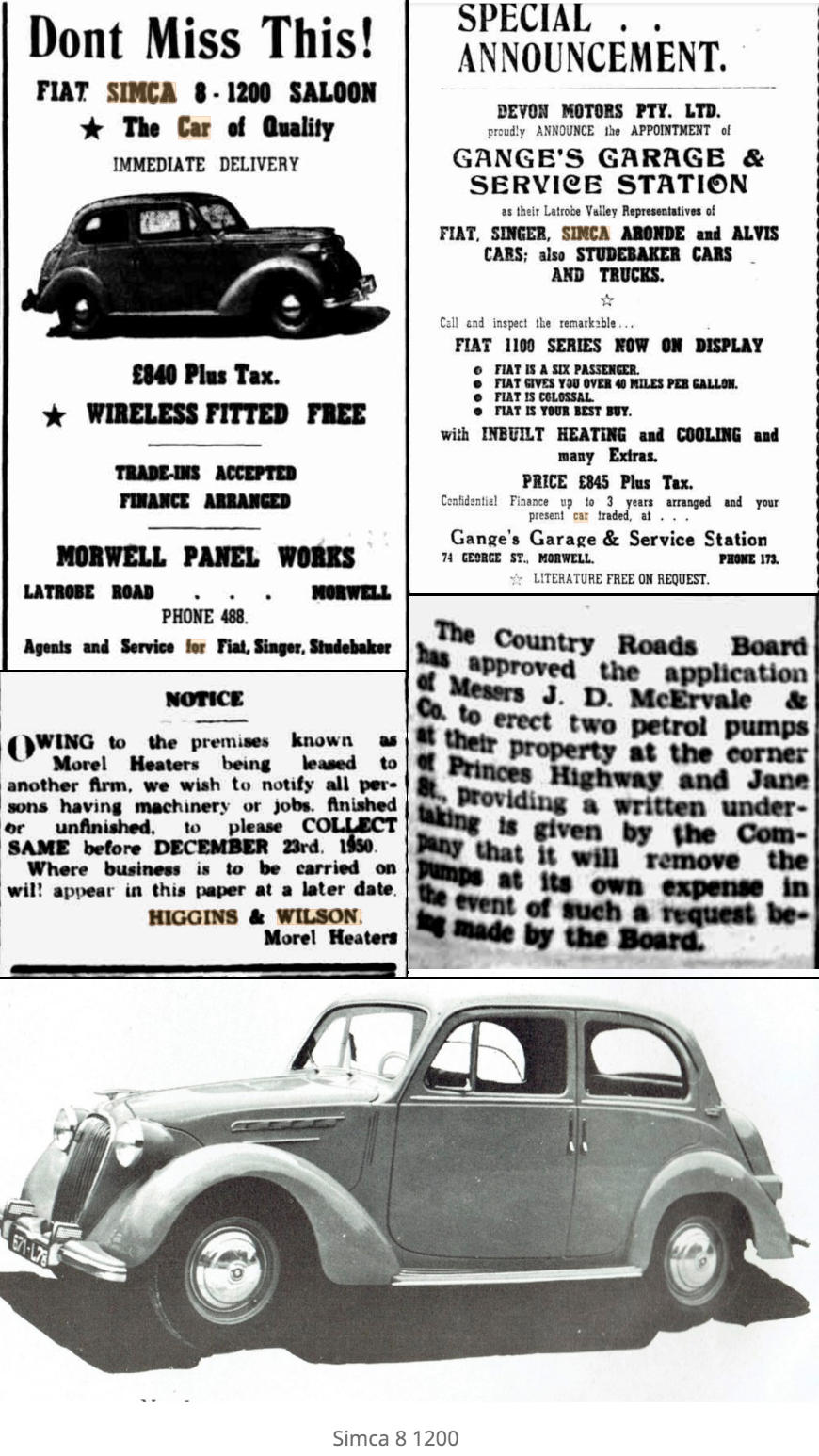
Actually, ‘SIMCA’ is an acronym - la Societe Industrielle et mecanique des constructions automobiles (i.e Industrial and Mechanical Automobile Construction Company) founded in 1934 by an Italian entrepreneur and distributed as Fiat in France. While commencing its life as a Fiat, in around 1951, the car was sold as a Simca.
In Morwell, Gange’s Garage in George Street was announced in early 1954, as the place to buy a Simca. And, there was a competitor - Morwell Panel Works - who during 1953, was selling a Fiat Simca. Note the other brands beginning to forge a new market.
It was the early 1950’s and petrol was in demand. During late 1952/early 1953, J D McErvale & Co made application to Morwell Shire to erect two petrol pumps on a property, corner Jane Street and Princes Highway. (Such an irony - there’s a petrol station there now. Or it may have been the former Travalley Motors site opposite.)
McErvale & Co were keen to promote their business presence. On Thursday February 8, 1951, it was announced the company had taken over the Higgins & Wilson business - who specialised in briquette hot water units, for homes and dairies.
The company rebadged themselves as automotive and agricultural engineers; even being dealers for International Harvester. The two pumps would sell Shell petrol; monetary donations were made to various community groups in town; even giving 11/6d towards funding the 1954 Royal Tour into Morwell. (Morwell Sire Council gave £15.00.)
Another piece of local history is from Hazelwood North where the former Presbyterian Church building is falling into disrepair. Numerous questions are asked as to what’s its future is - albeit privately owned by an absentee landlord.
During the late 1880’s, Hazelwood North boasted a strong, committed Presbyterian community. A block of land was donated by the Wuttrich family who first settled here in 1881. Leon Wuttrich was the first church secretary, and he played a key role ensuring a third Presbyterian church anniversary was celebrated on Wednesday May 7, 1884.
Attendees from the immediate area and Morwell apparently had to “wade, ride or walk” through mud to join in. Church decorations included ferns and chrysanthemums; almost 150 persons enjoyed a sumptuous afternoon tea.
That early church building was unfortunately a victim of the 1944 fires which raged everywhere. However, not to be beaten - a new brick church “rose from the ashes” and was dedicated on Saturday February16, 1946. Just over £303 was raised from donors who attended a combined Presbyterian and Methodist service.
A week after the church was dedicated, a wedding was conducted in the “new” church - Irene Gray married Donald Barnett. Their tiered wedding cake was decorated by Miss Queenie Bolding.