
Looking Back - History needs to be as accurate as practicable
By Leo Billington
Accurate portrayals do not just please discriminating enthusiasts of local history — they honour the lives and struggles of real people. Whenever one watches an historical film or reads an historical novel, imagine if it were your life, your family, your community being depicted. Any bits missing will annoy anyone; particularly when those missing bits are available in the first place.
Let us take an example. Leon Wuttrich was 18 years old when he and his parents selected land at Hazelwood North. From here, the family moved to Moe in about 1905.
After arriving in Australia from Switzerland, Leon’s parents, Marie and Alphonse Wuttrich first settled at Moorabool Viaduct, Batesford (near Geelong), where they had a vineyard and orchard. It was when they were journeying between Africa and Australia, that Leon was born on May 24, 1854. Leon was widely considered a true dinky-di Gippslander until his death in 1938, his father having died 25 years earlier, and his mother many years previously.
There is another more complete story to be told about the family’s selection of approximately 280 acres of what was described back in 1881, “rough, heavily timbered country”.
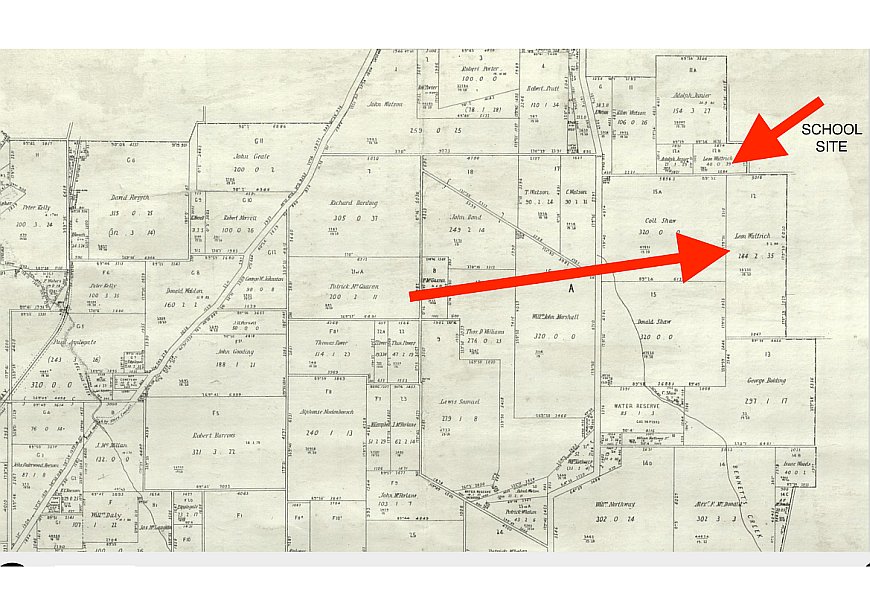
Six years later, Leon and his parents were “running a general and dairy farm, breeding cattle, horses and pigs. The farm was able to send about 100 pounds of butter weekly to Melbourne, using in its production, a cream-separator worked by horse power. They also have planted 100 acres with walnut trees, partly enclosed with a whitethorn hedge and looking remarkably well.” (Victoria and Its Metropolis 1887 - Short Biographies of Early, Morwell-District People.
They first resided at Hazelridge, a property later acquired by Mr. Robert Porter. Among the many activities of Mr. Wuttrich and family, while residing in Hazelwood was the pioneering of the winemaking industry in this district. The family quickly earned a reputation for ingenuity as a dairy farmer.
One innovation he promoted was the DeLaval cream separator, initially invented in 1878 by Swede Gustaf De Laval and the Dane, L. C. Nielsen when they made the first practical centrifugal cream separators. DeLaval was formally established in 1883 by Gustaf.
In February 1886, Leon proudly announced he had made an arrangement with the Gippsland Dairy Company to supply that company with 20 quarts of cream per day. With his acquisition of a new DeLaval Cream Separator, he believed he could earn greater profits by selling cream rather than making butter. Basically, Leon was also inviting others to learn about new technology.
While at Hazelwood North, he donated land sited opposite his farm on which the Hazelwood North Mechanics Institute was built, surrounded by trees planted by himself. These days, the Hazelwood North Community Hall and the former Hazelwood North Presbyterian Church stand on part of Walnut Park.
The Hazelwood North Community hall and church, to which he made many gifts, stand on part of the family property. Leon’s eldest child, Melina, died at the age of 8 1/2 months, and, with their daughter (Cosette) and son (Fred/Frederic), the latter of whom succumbed to an attack of appendicitis in 1915, they moved to Moe and took up land adjoining the main drain, and built their home, Leonville.
Back to Hazelwood North, an area fast becoming a social and cultural centre for “Morwellians” prepared to travel out from Morwell, the Wuttrich family would invite the public to enjoy picnics under the trees. Celebration of New Year’s Day was an opportune time for picnicking at Wuttrich’s farm. Expectations of large musters during the late 1890’s gave added excitement.
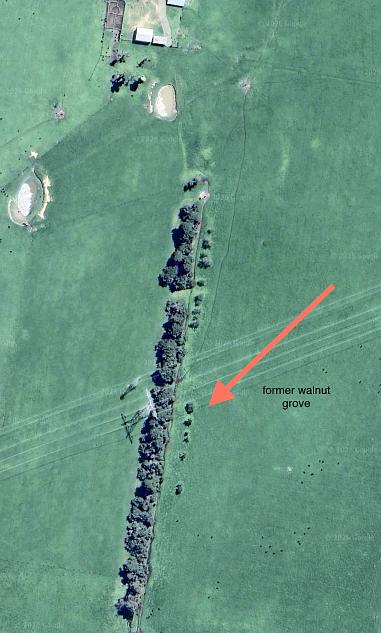
Even during the early 1990’s, students from Hazelwood North State School would enjoy visits to the walnut grove, having fun collecting fallen walnuts. During this decade and afterwards, “tired trees” were removed.
In addition to a reputation for giving away bunches of home grown flowers, a visiting correspondent wrote the family “has a fine lot of vegetables growing in his park and I understand the Morwell people will be given an opportunity of securing some.” (Morwell Advertiser, April 14, 1899.)
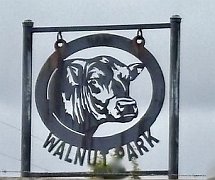
Although the walnut grove is no more, the farm, since owned by other families, is still known as Walnut Park.
It was reported (Morwell Advertiser July 1904) that Mr John Graham purchased Walnut Park, from Mr Leon Wuttrich. He made extensive alterations, and local residents predicted that this will be a future model farm of the district.
George Jones was the next owner. For a time he was share-farming on property then owned by Mr George Bond, at Hazelwood. (Hence the name for Bonds Lane.) George subsequently purchased Walnut Park, where he successfully carried on farming and resided until the time of his death in September 1939.
Interest in the significance of Leon Wuttrich and his family, while living at Hazelwood North was prompted by a family relative, living interstate and an avid reader of the Churchill & District News. The Wuttrich family’s place in Moe’s history has been well documented.
Equally, the Wuttrich family’s place in Hazelwood North’s history needs to be documented. There is a definite case for memorialisation of this family.
At about the same time when local selectors were taking up land, Paul Applegate selected his 320 acres in 1876 at Hazelwood. Previously he had farmed at Moorabool Viaduct, Batesford (near Geelong). The families knew each other.